Water availability
Start with the question everything else depends on: where would water actually come from?
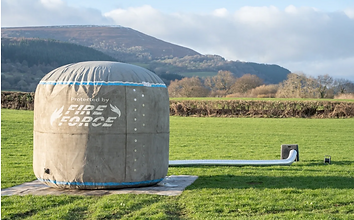
Identify every usable source on or near the property — wells, tanks, creeks, ponds, dugouts — and note how each one behaves through the season, since many shrink exactly when risk peaks. Then ask how water would reach a fire: whether a pump could draft from it, whether a truck or trailer could reach it, and how much could realistically be held on site.
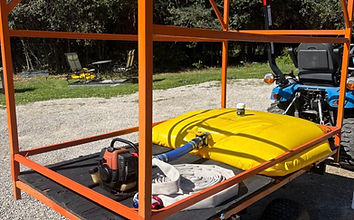
For most rural properties, the practical step is to stage water in advance in portable collapsible reservoirs, positioned where delivery equipment can reach them, and to plan refills rather than assuming a single source will last.
Access
Access determines whether any equipment — yours or a responder's — can reach where it needs to go.
Walk the routes a loaded trailer or fire apparatus would take onto the property: gate widths, driveway clearance, overhead branches, bridge limits and turnaround space. Note the spots that would slow down or stop a response. Keep primary routes trimmed and passable through fire season, and make sure someone other than you knows how to get in.
Defensible space
Defensible space is the fuel-managed zone around structures that gives embers less to ignite and radiant heat less to reach.
Priorities in order: clear roofs and gutters, move combustibles away from walls and under decks, break up continuous vegetation nearest to buildings, and keep the immediate surroundings low, green or non-combustible through fire season. Published local guidance should be followed for the specific distances and standards that apply to your property.
Equipment
Preparedness equipment is only an asset if it is complete, working and known to the people who would use it.
A practical baseline includes a pump kit, hose in workable lengths, nozzles and sprinklers, fittings and manifolds, and the fuel and maintenance items the pump needs. Check everything at the start of fire season and periodically through it: test-run the pump, inspect hoses and gaskets, and confirm every adult on the property can start and operate the equipment without instruction.
Property layout
Layout decisions either help or hinder every other measure.
Locate water storage where delivery equipment can reach it and where it can defend the structures that matter most. Keep fuel storage, firewood and combustible materials separated from buildings. Identify, in advance, which structures would be protected first if response capacity is limited — and make sure access and water reach that priority list.
Emergency planning
A written plan turns equipment into a coordinated response.
Define the triggers that activate the plan, who does what, what gets protected first, and — critically — the conditions under which everyone leaves. A plan that does not include evacuation criteria is incomplete; no equipment outranks human safety.
Communication
During an event, information and coordination are as important as water.
Maintain a current list of emergency numbers, establish how the household or crew will reach each other if separated, designate who is responsible for contacting emergency services, and keep charged phones, radios or a backup communication method staged with the equipment.
Staged response equipment
The final layer is positioning: response capability placed where the event will actually happen, not stored where it is convenient.
Staging means reservoirs filled or fillable at the points of use, pumps and hose reachable without searching, sprinklers ready to be set, and everything pre-rigged so that activating the plan is a matter of minutes rather than hours. Equipment staged this way supports wet-downs, sprinkler coverage and small-ignition response during the stages when action is still possible.